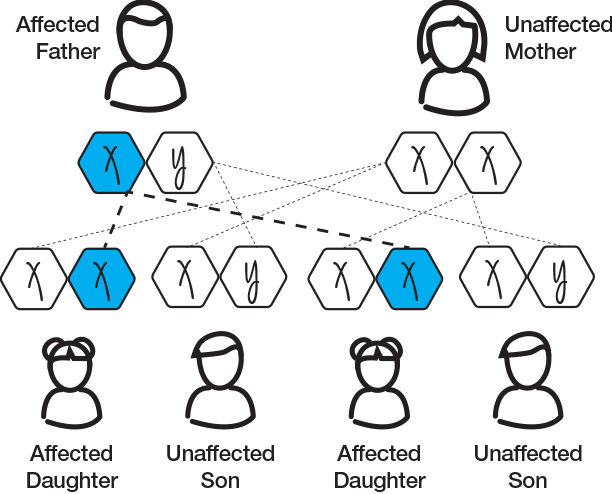
Men and women can both be affected by Fabry but the likelihood of a father or a mother passing down the Fabry mutation is not the same. It depends on the chromosomes they pass onto their children.
What is a genetic mutation?
Genetic information is stored in DNA, providing instructions that tell every cell in your body what to do. Mutations can occur in DNA, these are errors in the instructions.
The X and Y chromosomes determine the sex of a person.

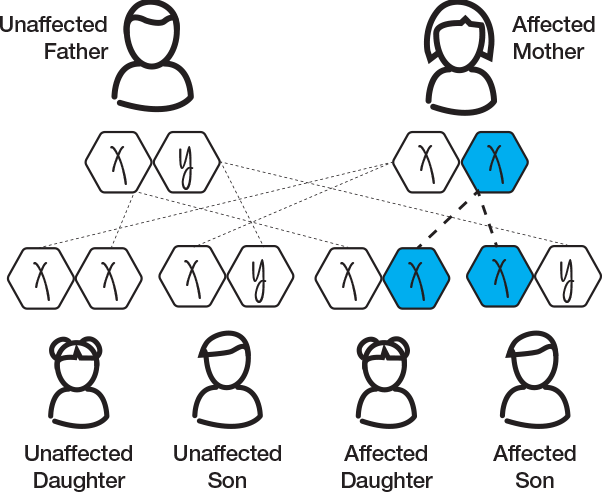
Women have two X chromosomes – sons and daughters will randomly receive one of these X chromosomes
A mother affected by Fabry disease has a 50:50 chance of passing the Fabry mutation onto any of her daughters or sons:
- This is because the mother has two X chromosomes, and either the X chromosome with the Fabry mutation or the X chromosome without the Fabry mutation could be passed onto her children
- Which X chromosome is received is completely random, so it could be that a mother passes the Fabry mutation to all or none of her children, and any combination in between

Men have one X and one Y chromosome – sons will receive the Y chromosome and daughters the X chromosome
A father affected by Fabry disease will pass the Fabry mutation on to all of his daughters but none of his sons:
- This is because the father only has one X chromosome that must contain the Fabry mutation – his daughters will inherit this, but his sons won’t (they will inherit his Y chromosome)